
In short
At a large shopping mall in Istanbul, Amanos designed a system that recovers chiller condenser heat — currently rejected through cooling towers — and upgrades it to domestic hot water with a ~1 MWth high-temperature heat pump. The pre-feasibility study shows that supplying summer hot water from the heat pump instead of natural gas cuts the unit cost of heat by about 60%, with a 3.4–4.3-year simple payback. All values are calculations based on real consumption data, not field measurements.
| Project facts | |
|---|---|
| Building | Large shopping mall, Istanbul |
| Status | Pre-feasibility completed (September 2026) |
| Existing heating | Gas boilers, ~8.4 MW installed; in summer one ~1 MW boiler runs for hot water only |
| Existing cooling | 2 centrifugal + 1 screw chiller, ~7.7 MW nominal |
| Waste heat source | Common chiller condenser water header, 35–38°C (observed on site) |
| Proposed system | ~1,000 kWth high-temperature heat pump, 4 staged compressors |
| Design point | Target heating COP 6.3; evaporation ~30°C |
| Period analysed | June–September 2025 actual consumption (122 days) |
| Unit cost of heat | Gas ~2.50 TRY/kWh → heat pump ~1.00 TRY/kWh |
| Simple payback | 3.4–4.3 years (estimate, dependent on investment cost and economic assumptions) |
| Net CO₂ reduction | ~298 t per summer season |
The energy problem
In summer, two energy flows run side by side without talking to each other: one burns gas to make hot water, the other rejects chiller condenser heat to the atmosphere through cooling towers.
- Gas → boiler → domestic hot water. With no space heating in summer, boilers run for hot water only. June–September gas use is about 10% of the annual total and goes almost entirely to hot water.
- Chiller → condenser → cooling tower → atmosphere. In the same months the chillers run most of the day, and the heat carried by 35–38°C condenser water is thrown away.
The site pays for fuel to make heat on one side and for tower fans and pumps to reject heat on the other. This is not a boiler replacement project; it is an energy integration project that links the two flows through one heat pump.
System analysis
The ~841 kW of source heat the heat pump needs stays within condenser load even in the smallest chiller configuration. On the demand side, summer hot water equals ~1,950 MWh of useful heat.
Waste heat source. A chiller's nominal cooling capacity is not the heat it rejects; compressor power is rejected at the condenser too:
Q_condenser = Q_cooling + P_compressor
All chillers share one condenser header, so the heat pump can draw from it whichever chillers are running. Its share of total condenser load depends on the active chillers:
| Active chillers | Nominal condenser load (kW) | Heat pump share |
|---|---|---|
| 2 centrifugal | 7,710 | ~11% |
| 1 centrifugal + 1 screw | 5,138 | ~16% |
| 1 centrifugal | 3,855 | ~22% |
| 1 screw | 1,283 | ~66% |
Hot water demand. June–September 2025 gas use, converted at 10.5 kWh/Sm³ (net calorific value) and 85% boiler efficiency, equals about 1,950 MWh of useful heat — the reference for all energy and cost figures.
Engineering approach and system architecture
The heat pump draws heat from the common condenser header and delivers it to the existing hot water network without altering the chillers or boilers. Boilers stay in place for peak load and backup.
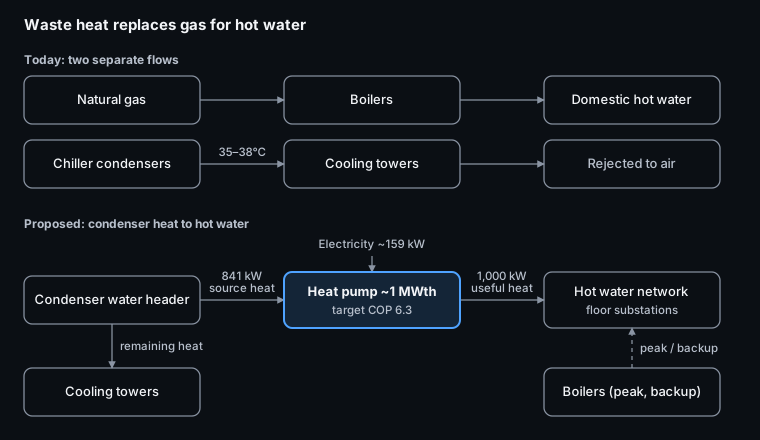
At the design point the heat pump combines ~841 kW of waste heat with ~159 kW of electricity to deliver ~1,000 kW of useful heat; heat sent to the towers falls by the same amount.
Key engineering decisions:
- Sized to the summer boiler. One ~1,040 kW boiler carries summer hot water today; the 1,000 kWth heat pump is sized to take its place.
- Two separate circuits. Condenser water (35–38°C) and the heat pump's refrigerant circuit (evaporating at ~30°C) exchange heat through a heat exchanger. 30°C is the heat pump's own evaporating temperature, not a target for the condenser water.
- Chiller hydraulics protected. The source side connects through its own pump, flow control valve and bypass, so condenser water keeps flowing to the towers if the heat pump stops.
- No new storage. The system ties into the site's existing floor substations (heat exchangers); no new calorifier or buffer tank is added.
- Staged capacity. 4 × ~250 kWth compressors follow the varying hot water load and provide partial redundancy.
Energy and economics
At the target COP of 6.3 the same hot water costs about 60% less in energy than with gas. Even at COP 4.5 the saving is 44% and payback stays under 6 years.
Energy balance (design point): P_el = Q_h / COP = 1,000 kW / 6.3 ≈ 158.7 kW; Q_evap = Q_h − P_el ≈ 841.3 kW.
Summer season: covering all ~1,950 MWh of useful heat from the heat pump needs ~309.5 MWh of extra electricity, about 10% of the site's summer electricity use.
Unit cost of heat. With Istanbul reference prices for large commercial users (electricity 6.3 TRY/kWh, gas 22.3 TRY/Sm³, taxes included), 1 kWh of useful heat costs ~2.50 TRY from gas and ~1.00 TRY from the heat pump. These are pre-feasibility references, not the site's tariffs.
COP sensitivity. The variable that moves the result most is the COP the heat pump reaches in operation. With the same price and demand assumptions:
| Heating COP | Extra electricity (MWh/summer) | Cost of heat (TRY/kWh) | Saving vs gas | Simple payback (estimate) |
|---|---|---|---|---|
| 6.3 (target) | 309.5 | 1.00 | 60% | 3.4–4.3 years |
| 5.5 | 354.6 | 1.15 | 54% | 3.8–4.7 years |
| 5.0 | 390.0 | 1.26 | 50% | 4.1–5.2 years |
| 4.5 | 433.4 | 1.40 | 44% | 4.7–5.8 years |
Payback is an estimate: it depends on the investment cost and economic assumptions, and assumes the June–September saving repeats each year at an exchange rate of ~50 TRY/EUR.
Additional chiller-side benefit and carbon
Because the heat pump draws heat from the condenser loop, the chillers run on cooler condenser water. The benefit is real, but it is left out of the main result until manufacturer performance curves quantify it.
- Condenser water temperature: at one centrifugal chiller's nominal flow (~553 m³/h), an 841 kW draw cools the water by ~1.3 K (35°C → ~33.7°C).
- Compressor saving (indicative): a lower condensing temperature reduces the compressor's pressure ratio. A 3–5% compressor power reduction scenario would add roughly 10–16% on top of the main saving.
- Tower load: over the summer ~2.46 GWh of heat goes to hot water instead of the towers. This is a reduction in rejected heat, not an electricity saving.
Carbon Emissions Reduction (Summer Period)
| Item | Emissions Impact (tCO₂) |
|---|---|
| Avoided natural gas emissions | 437 |
| Heat pump electricity emissions | −139 |
| Net emissions reduction | 298 |
The potential additional electricity savings resulting from lower chiller condensing temperatures, and their associated carbon impact, are not included in this calculation.
Note: Emission factors are approximate reference values. Results are estimates calculated as part of a pre-feasibility study and do not represent field measurements or verified emission reductions.
Limits and data to confirm
This is a pre-feasibility study; the following will be confirmed on site before an investment decision.
| Parameter | Approach in this study | How it will be confirmed |
|---|---|---|
| Heat pump COP | Design target 6.3 | Equipment selection and commissioning measurement |
| Condenser water flow | One chiller's nominal flow (~553 m³/h) | On-site flow measurement |
| Simultaneity | All summer hot water from the heat pump | Hot water demand when chillers are off; boilers cover those hours |
| Substation flows and return temperatures | General integration logic | Site records |
| Chiller compressor saving | 3–5% indicative scenario | Manufacturer performance curve |
| Energy prices | Istanbul reference prices | The site's current invoices |
Because the boilers stay in place, these uncertainties affect the size of the saving, not operational continuity.
Frequently asked questions
Can chiller waste heat produce hot water in a shopping mall?
Yes. At 35–38°C condenser water is too cool to use directly; a high-temperature heat pump lifts it to domestic hot water temperature. This study sized a 1 MWth system to supply summer hot water from this source instead of gas.
Is this a boiler replacement?
No. Boilers stay in place for peak load and backup. The project redirects heat that the towers would otherwise reject.
Does the heat pump reduce chiller efficiency?
The opposite. Drawing heat from the condenser loop cools the condenser water, so the chillers run at a lower condensing temperature. The size of this extra benefit will be confirmed with manufacturer curves.
What happens in winter?
Chillers do not run in winter, so this waste heat source is unavailable. The study covers June–September only; existing boilers handle winter heating.
What is the payback period?
3.4–4.3 years at the target COP of 6.3, and 4.7–5.8 years at COP 4.5. This is an estimate that depends on the investment cost and economic assumptions; the calculation uses the summer saving only.
Which buildings is this suitable for?
Buildings with simultaneous cooling and hot water demand: shopping malls, hotels, hospitals and mixed-use complexes. What matters is that cooling and hot water demand occur at the same hours.
Next step
If your site needs both cooling and hot water in summer, we prepare a similar pre-feasibility study from your existing consumption data. Schedule a technical meeting.